Growth marketing is a way of growing revenue by learning faster. It uses customer data, testing, and full journey thinking to find what works, then scale it. It is not just ads, and it is not a “hack.” For business owners, it is a practical way to reduce wasted spend and build steady growth.
TL;DR
- Growth marketing focuses on the full customer journey, not just getting clicks.
- It relies on measurement and fast testing to improve outcomes over time.
- It includes acquisition, conversion, retention, and referral, not only top of funnel.
- It works best when you can track what matters: revenue, lead quality, and repeat purchases.
- It pairs well with brand marketing and performance marketing, it does not replace them.
Table of contents
– What is growth marketing?
– Why does growth marketing exist?
– What does growth marketing focus on across the customer journey?
– Growth marketing vs performance marketing vs brand marketing
– Is growth marketing the same as growth hacking?
– What does a growth marketing team actually do?
– Which metrics matter most in growth marketing?
– Is growth marketing right for your business?
– How Komplex supports growth marketing
– Growth Marketing FAQ
What is growth marketing?
Growth marketing is a data informed approach to marketing that improves growth by testing and optimizing the entire customer journey. That means you look at how people discover you, what gets them to take action, and what keeps them coming back. The output is not “more activity,” it is a repeatable growth system that improves over time.
Most definitions agree on the core idea: growth marketing uses customer insights, testing, and cross channel execution to improve measurable business outcomes. It also includes retention and loyalty, not only acquisition.
Why does growth marketing exist?
Growth marketing exists because most businesses do not have an awareness problem, they have an efficiency problem. You can spend on ads and content, but if the site does not convert, onboarding is weak, or customers do not return, growth stalls. Growth marketing puts attention on the points where money and time usually leak out.
It is also a response to how fast markets change. Customer expectations shift, platforms shift, and what worked last quarter can stop working today. Growth marketing assumes change is normal, so it builds a habit of measuring and adjusting.
What does growth marketing focus on across the customer journey?
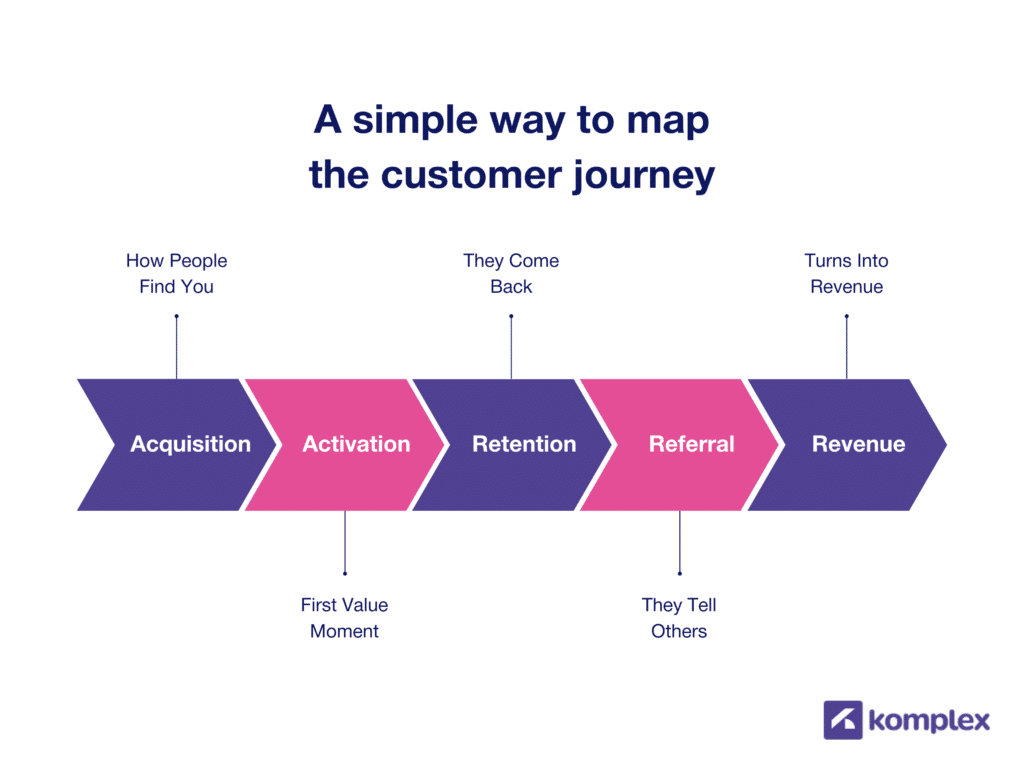
Growth marketing focuses on the full customer journey from first touch to repeat purchase and referral. A common way to describe that journey is the AARRR framework: Acquisition, Activation, Retention, Referral, and Revenue. You do not need to use the acronym, but the logic is useful for leaders because it forces you to ask, “Where are we losing people?”
A simple way to think about full journey growth
- Acquisition: How people find you (search, paid, social, partners).
- Activation: The moment they see value (signup, first purchase, first “win”).
- Retention: Why they come back (repeat orders, renewals, usage).
- Referral: Why they tell others (sharing, reviews, invites).
- Revenue: How the business makes money (conversion rate, margin, LTV).
Some modern teams also talk about “growth loops.” A loop is a system where an output feeds the next input, so growth compounds. For example: great product experience leads to reviews, reviews drive new buyers, new buyers create more reviews.
Growth marketing vs performance marketing vs brand marketing
Growth marketing is broader than performance marketing and more measurable than brand marketing. Performance marketing usually focuses on trackable actions like leads or sales, often near the bottom of the funnel. Brand marketing focuses on awareness and preference. Growth marketing connects both by improving how people move through the whole journey and by measuring outcomes, not just activity.
Growth marketing vs performance marketing
Performance marketing is often about immediate return from campaigns. Growth marketing still cares about results, but it also cares about what happens after the click: conversion, repeat purchase, retention, and referrals. In practice, a growth approach can reduce the pressure to constantly “refill the funnel” with more paid spend.
Growth marketing vs brand marketing
Brand marketing shapes how people feel about your company. Growth marketing shapes what people do, and why. Strong brands still need growth work, and strong growth programs still benefit from brand. If you are a business owner, the best outcome is when brand and growth support the same story and the same customer promise.
Ready to Make Growth Marketing Measurable?
Komplex helps business leaders turn growth marketing into a clear system: the right channels, clean tracking, and steady improvement across the full customer journey. If you want a plan you can trust and report on, explore our Growth Marketing services.
Is growth marketing the same as growth hacking?
No. Growth marketing is a long term discipline, while growth hacking is often used to describe early stage, fast experiments. Both rely on testing and data. The difference is tone and scope. Growth marketing is typically more structured, more cross functional, and focused on sustainable results, not clever one off tactics.
In other words, growth marketing keeps the useful parts of “growth hacking” (speed, learning, measurement) and drops the hype.
What does a growth marketing team actually do?
A growth marketing team connects channels, messaging, and the website experience to improve measurable outcomes. The work can sit inside marketing, or it can cut across marketing, product, and sales. The goal is to find the biggest constraint to growth, then fix it with focused tests and improvements.
Common growth marketing work, in plain language
- Message and offer testing: clarifying what you sell and why it matters.
- Landing page improvement: making pages easier to understand and act on.
- Lead quality improvements: attracting fewer wrong leads and more right ones.
- Lifecycle messaging: email and SMS that help people buy again or upgrade.
- Paid media optimization: improving targeting and creative, then measuring true impact.
- SEO aligned to revenue: content that attracts qualified buyers, not just traffic.
Examples (no client stories, just typical situations)
- Ecommerce: You are getting traffic, but checkout drop off is high. Growth marketing looks at the full flow, not only ads. That can include product page clarity, shipping and returns trust signals, and cart recovery email.
- B2B services: You are getting leads, but sales says they are unqualified. Growth marketing works on better targeting, better lead capture, and clearer positioning so fewer people waste time on both sides.
- SaaS: You get signups, but users do not stick. Growth marketing focuses on the “first value” moment and the messaging that gets users there sooner.
Which metrics matter most in growth marketing?
Growth marketing metrics are the numbers that tell you if growth is real, profitable, and repeatable. The right set depends on your model, but leaders should insist on metrics that connect marketing effort to business results, not vanity metrics.
Core metrics most leaders should understand
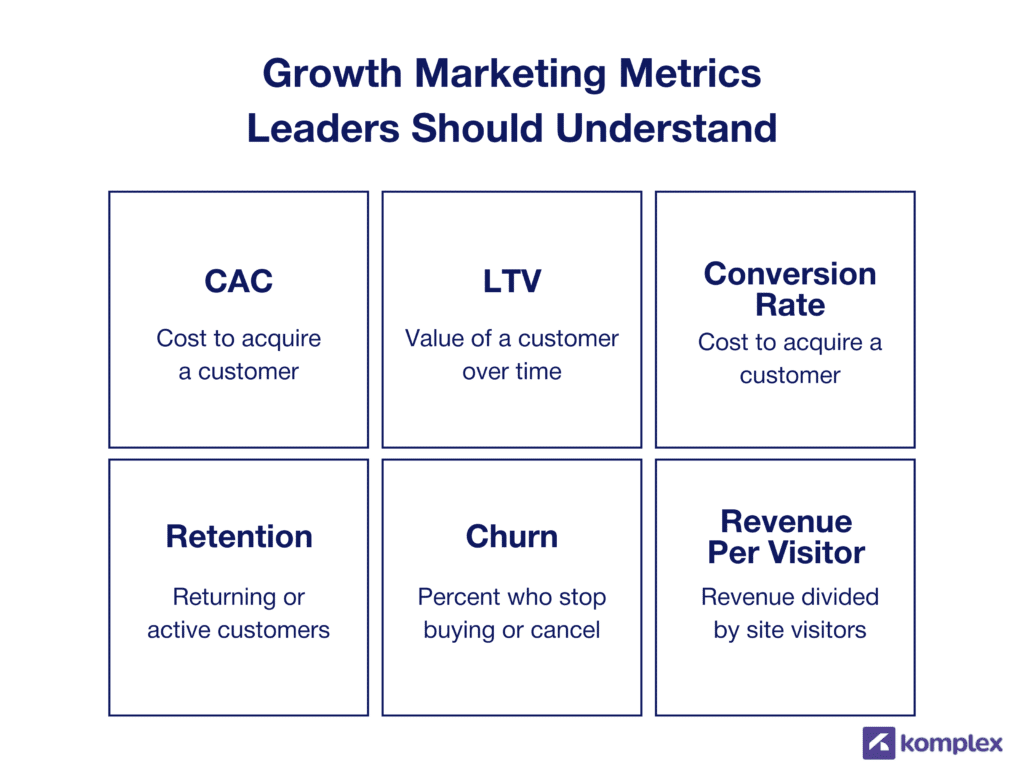
- CAC (Customer Acquisition Cost): what it costs to win a customer.
- LTV (Lifetime Value): how much a customer is worth over time.
- Conversion rate: how many visitors turn into leads or buyers.
- Retention: how many customers come back, renew, or stay active.
- Churn: how many customers stop buying or cancel.
- Revenue per visitor or per lead: the fastest way to connect traffic to money.
If your reporting stops at clicks, impressions, or traffic, you are not seeing the full picture. Growth marketing pushes measurement deeper so decisions get easier.
Is growth marketing right for your business?
Growth marketing is a fit when you want measurable growth and you are willing to learn from data. It is especially useful when you already have demand, but results feel inconsistent, costs are rising, or retention is weak. It is less effective when tracking is unreliable or the offer is unclear.
Good signs you are ready
- You have a product or service that customers already buy, and you want to scale it responsibly.
- You can track leads, sales, or revenue with reasonable accuracy.
- You want to improve efficiency, not just increase spend.
Signals to fix first
- You cannot measure basic outcomes (leads, sales, pipeline, revenue).
- You do not know who your best customer is yet.
- Your offer is still shifting weekly, so marketing cannot stay consistent.
How Komplex supports growth marketing
If you want a growth marketing partner, the goal should be simple: fewer wasted moves, clearer decisions, and steady improvement in the metrics that matter. At Komplex, our work is built around measurement, testing, and full funnel thinking across channels like paid search, paid social, SEO, CRO, email, and more.
If you want to see how we approach it, you can start here: Growth Marketing Services.
FAQs About Growth Marketing
Common Questions About Growth Marketing
Is growth marketing only for startups?
No. Startups use it because they need fast learning, but established companies use it to improve efficiency, reduce waste, and increase customer value over time.
Does growth marketing mean “more paid ads”?
No. Paid ads can be part of it, but growth marketing also includes conversion improvements, retention, lifecycle messaging, and better measurement.
Is growth marketing the same as digital marketing?
Digital marketing describes channels like search, social, and email. Growth marketing is how you run those channels with a focus on testing, learning, and improving outcomes across the full journey. The term is also used when talking about paid marketing channels and channels that are focused on acquiring customers.
What is the biggest mistake leaders make with growth marketing?
They treat it as a channel. Growth marketing is a system. If you only “add growth marketing” without better measurement and follow through, it turns into random tactics. Experience of the individual and/or partner you work for is also important, as many can launch growth marketing campaigns, but not all can fully optimize them.
How does growth marketing relate to retention?
Retention is a core part of growth marketing. Many definitions emphasize that growth work does not stop at the first sale, it includes loyalty and repeat behavior.
Do I need a big team to do growth marketing?
No. You need clarity on goals, reliable tracking, and the ability to test ideas. A small team can do meaningful growth work if it stays focused.
How long does growth marketing take to show results?
Some improvements show quickly (like conversion fixes). Others take longer (like SEO or lifecycle programs). The most important outcome is a steady, measurable trend in the right direction.